

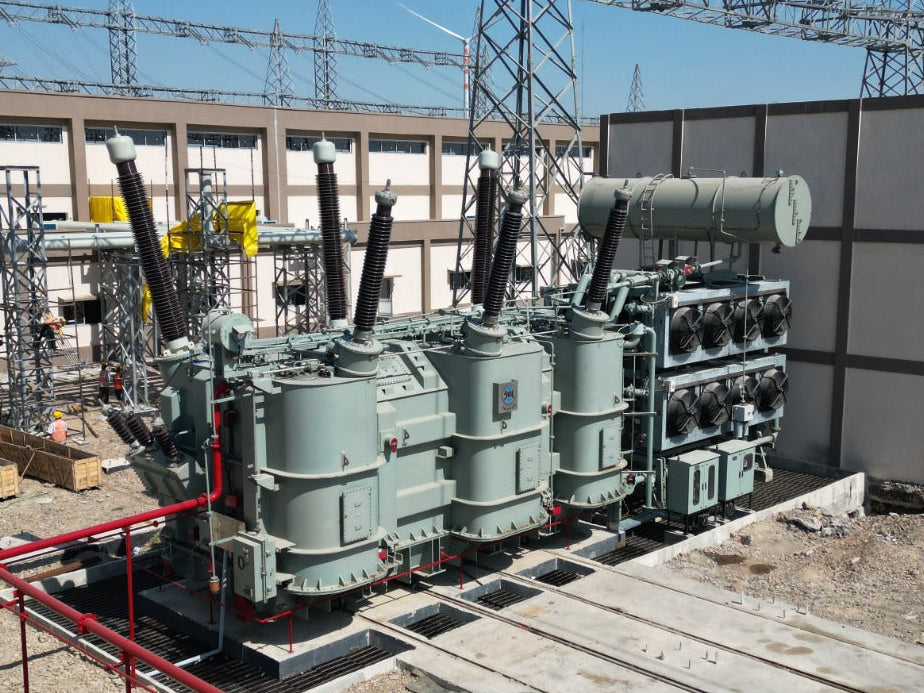
An auto‑transformer is a special type of transformer that uses a single continuous winding, part of which is common to both the primary and secondary circuits. This design makes it more compact, economical, and efficient compared to a conventional two‑winding transformer, especially when the voltage ratio between input and output is close. Because less copper and core material are required, auto‑transformers have lower losses, better voltage regulation, and higher efficiency.
The purpose of auto‑transformers in power systems is to step up or step-down voltages in Extra High Voltage (EHV) transmission networks, typically for interconnecting grids operating at slightly different voltage levels (e.g., 1200 kV to 400 kV). They are widely used in bulk power transmission, system interconnection, and industrial applications where variable voltage control is needed. Their efficiency and cost‑effectiveness make them indispensable for modern transmission systems, though they are generally applied where galvanic isolation between circuits is not required.
Technical Details
- 500MVA,400kV 3 phase
|
Sr. No |
Rating (MVA) |
Voltage (kV) |
No‑Load Loss (kW) |
Load Loss (kW) |
%Z (Impedance) |
HV Impulse (kV) |
|
1 |
500 |
400 |
90 |
500 |
12.5 |
1300 |
- 500MVA,765kV 1 phase
|
Sr. No |
Rating (MVA) |
Voltage (kV) |
No‑Load Loss (kW) |
Load Loss (kW) |
%Z (Impedance) |
HV Impulse (kV) |
|
1 |
500 |
765 |
80 |
450 |
12.5 |
1950 |