

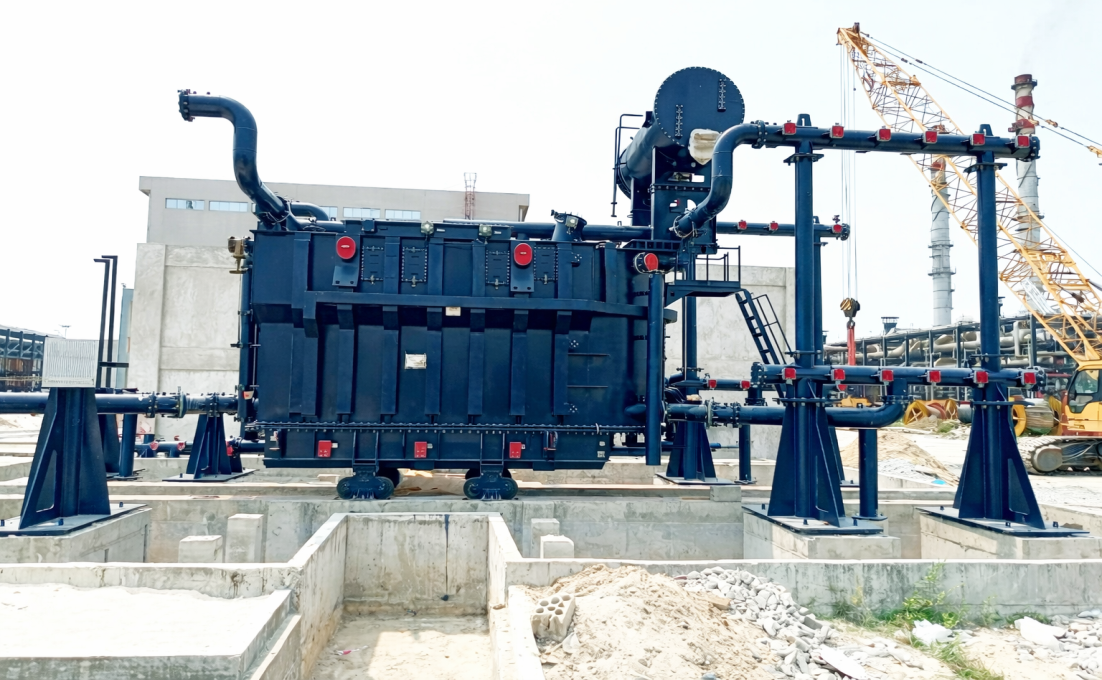
- Phase shifting transformer
- Traction transformers
- Isolation transformer
Phase shifting transformer.
A Phase-Shifting Transformer (PST) is a specialized device used in high-voltage transmission systems to control the flow of active power by adjusting the phase angle between voltages. Its main purpose is to regulate how electricity is distributed across parallel transmission lines, prevent overloading, and ensure that power flows follow contractual and operational requirements rather than just natural impedance paths. PSTs are particularly valuable in interconnected grids, where they mitigate unwanted loop flows, enable accurate cross-border power trading, and enhance overall system reliability. Technically, they improve grid stability by providing dynamic control during disturbances, reduce transmission losses by optimizing power flow, and support renewable energy integration by balancing variable generation from wind and solar sources.
- 200MVA,330/161kV 3 phase
|
Sr.No |
Rating (MVA) |
Voltage (kV) |
No‑Load Loss (kW) |
Load Loss (kW) |
%Z (Impedance) |
HV Impulse (kV) |
|
1 |
200 |
330 |
60 |
250 |
10.2 |
1175 |
Traction Transformer
A traction transformer is a specialized power transformer used in railway electrification systems to convert high-voltage supply from the overhead catenary into suitable voltages for train propulsion and auxiliary services. Typically, railway systems operate with input voltages such as 25 kV AC or 15 kV AC, and the traction transformer steps this down to levels required by traction motors, ensuring efficient and reliable train operation. Beyond propulsion, it also supplies power to onboard systems including lighting, air conditioning, signaling, and communication equipment, making it essential for both performance and passenger comfort.
- V-Connect Transformer-63MVA,220KV
|
Sr.No |
Rating (MVA) |
Voltage (kV) |
No‑Load Loss (kW) |
Load Loss (kW) |
%Z (Impedance) |
HV Impulse (kV) |
|
1 |
63 |
220 |
28 |
325 |
17.4 |
950 |
- Scott Transformer-100MVA,220KV
|
Sr.No |
Rating (MVA) |
Voltage (kV) |
No‑Load Loss (kW) |
Load Loss (kW) |
%Z (Impedance) |
HV Impulse (kV) |
|
1 |
100 |
220 |
48 |
450 |
17.4 |
950 |
Isolation Transformer-100MVA,66/66kV
An isolation transformer is a specially designed electrical transformer used to decouple two circuits, providing galvanic isolation between the input and output. Unlike conventional transformers that primarily step voltage up or down, the main purpose of an isolation transformer is to ensure safety, noise reduction, and protection in sensitive electrical systems. By isolating the secondary winding from the primary, it prevents direct electrical connection and eliminates the risk of shock hazards, ground loops, and unwanted current paths. This makes isolation transformers essential in medical equipment, industrial control systems, data centres, and laboratories where electrical safety and clean power are critical.
Technically, isolation transformers are built with a 1:1 voltage ratio, meaning the output voltage is equal to the input voltage, but the circuits remain electrically separated. They are designed to suppress electrical noise, reduce harmonics, and protect sensitive devices from surges or spikes in the supply. In industrial applications, they safeguard machinery and instrumentation from disturbances, while in IT and telecom environments, they ensure stable and interference-free operation of servers and communication equipment.
|
Sr.No |
Rating (MVA) |
Voltage (kV) |
No‑Load Loss (kW) |
Load Loss (kW) |
%Z (Impedance) |
HV Impulse (kV) |
|
1 |
100 |
66 |
50 |
300 |
10 |
325 |